


Proof of Concept for Software: The Smart Way to Build Digital Products
This proven process allows you to ascertain the viability of a product without spending a fortune or hundreds of staffing hours on something that just won’t work.
In short, proof of concept development can catch fatal flaws in days or weeks, rather than months.
Here at Digineat, we specialize in PoC for software, so you can move ahead with confidence. But in case you’re determined to plow on alone, here’s an overview of the process and what to expect.
Proof of Concept Definition
It’s like a very short experiment. You get to test whether your idea can be built in the real world.
PoC isn’t a prototype or an MVP (Minimum Viable Product); it’s like a reality check. Performed by experts, the proof-of-concept process discovers if the project is technically and financially feasible.
With the help of a PoC for a software specialist such as Digineat, you can find out whether your idea has legs in just a few weeks – and without blowing your bottom line on a non-starter.
Why Proof of Concept Development Should Come First

Don’t fall in love with “best idea you’ve ever had.” At least not yet. Reality doesn’t care about your desires. Nor does your bank balance.
Don’t go rushing in. Take a moment. Take a proof-first approach to protect your finances, reputation, and future.
There are many reasons why proof of concept in software development makes sense, but here are a few of the most compelling:
Mitigate Risks
Believe it or not, code isn’t the biggest killer of software development projects – building products that can’t work is. But a PoC can give you the answers you’re looking for, even if you don’t want to hear them.
An effective proof-of-concept development process can identify latency issues, security holes, scalability challenges, and integration hurdles before you blow most of your budget on turning your idea into reality.
Keep Costs Low
Reworking architecture after months of development can be 100 times more expensive than proving it doesn’t work in week two.
A focused PoC might cost you a few thousand dollars, and it may take up to six weeks. But you were about to sink more than a million into your idea. You’ve actually saved hundreds of thousands!
A NASA study showed that fixing defects during the testing phase can cost 21–78 times more than addressing them in the requirements phase. What’s more, costs can skyrocket by more than 1600%. The earlier you can prove your concept works, the more money, time, and effort you can save your team down the line.
Minimize Time-to-Market
If your idea really is that good, you can be fairly sure that someone else is already planning to launch something similar. The race to be first is on.
While this might sound counterintuitive, take a few extra weeks to carry out proof-of-concept development. It might help you speed up the entire process. You’ll identify issues that need to be addressed right at the beginning of the process – so you can build them into your product roadmap from the outset.
Secure Stakeholder Approval
As much as you’d like them to, investors aren’t there to fund your dreams – they’re there to make money. And they’ll only part with funds if they’re sure your idea is a viable concept that can be delivered in a timely, cost-effective manner.
When you present a potential investor with a finished PoC presentation, you’re providing the key metrics that can tip the balance in your favor.
Validate Third-Party Tools
To turn your idea into a viable product, you may need a series of third-party tools and technologies. But splashing out on hugely expensive contracts when you don’t know if your idea is feasible is a recipe for spiralling costs and, ultimately, failure.
Kick the tires during a software proof of concept process. Will your preferred tools and technologies actually deliver what you’re looking for – and at a price that makes sense?
When Is Proof of Concept in Software Development Necessary?

Using tools and technologies that have already been proven? Proof of concept for software probably isn’t necessary. Probably. An expert at Digineat will be able to tell you for sure.
Recognize any of these scenarios? Then it’s a good idea to press ahead on the PoC route:
- You’re using new tech
- Performance or scalability is non-negotiable
- One of your third-party systems is giving you cause for concern
- The architecture is particularly complex
- The potential budget is eye-watering
- Investors have specifically asked for hard evidence
For a different perspective on when and why it’s best to take the PoC route, take a look at what Simran Pandey has to say on the issue.
A Brief Guide to Successful Proof of Concept Development
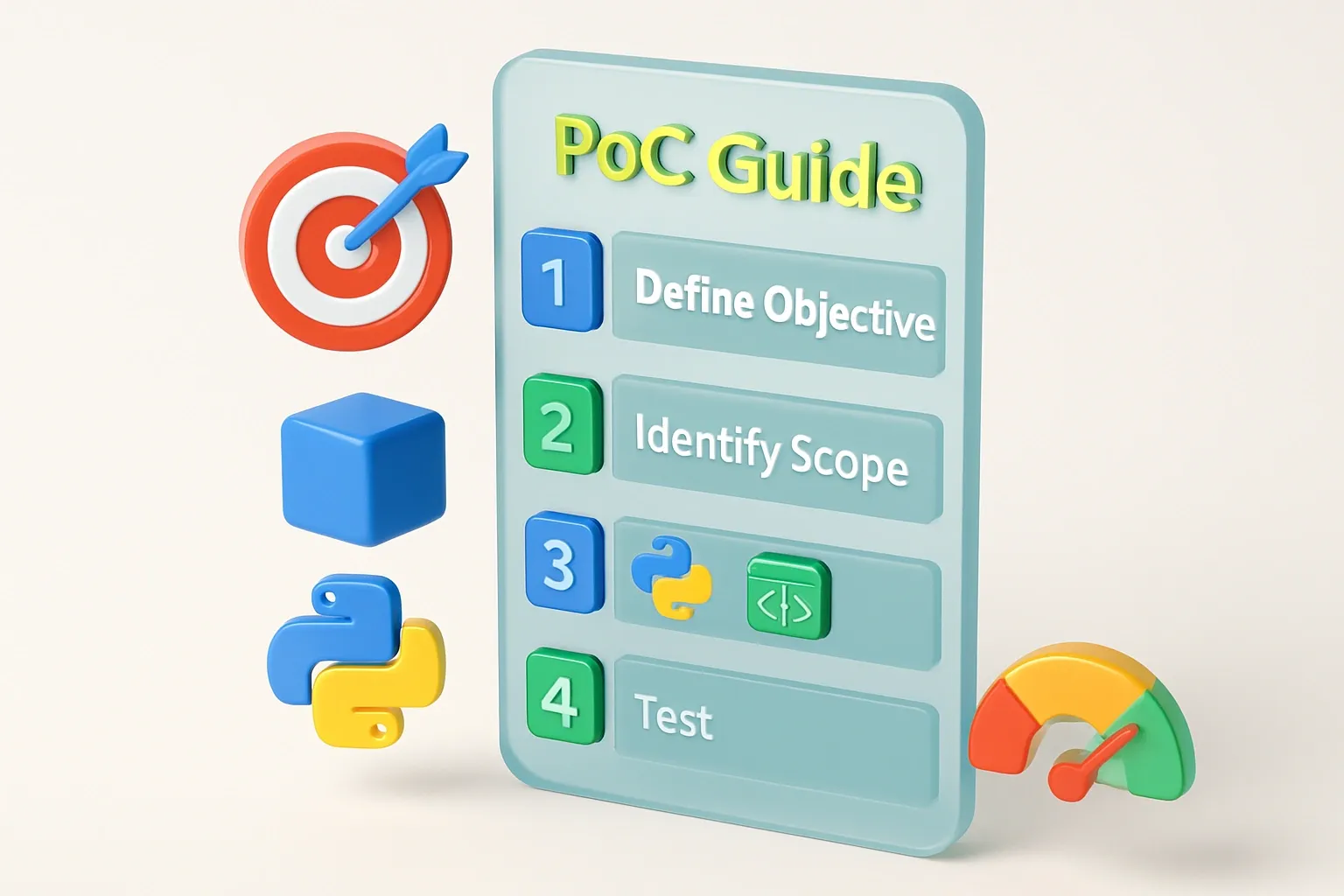
For the best chances of a wholly accurate result, we recommend approaching professional software developers for help with your proof-of-concept development journey.
Want to keep things in-house? Here’s a brief guide to what’s required:
Define the Objective. What Qualifies as Success?
What’s the ultimate purpose of the product? If you can’t write it down concisely, listen to the alarm bells ringing in your ears.
Can you turn the objective into numbers? If you’re creating a fintech application, for instance, can you obtain a certain number of sign-ups within the first three months? This is just an example. You and your team set the criteria.
Can’t measure it? Don’t do it!
Create a Narrow Scope
Leave the kitchen sink where it belongs. In other words: stick to a tight, highly-limited objective. Don’t throw features and functionality at it – particularly if they don’t support the delivery of your core objective.
Getting the essence of your idea over the line should be your only priority. You can build the product with additional features when you have a product to sell!
Choose the Right PoC Tools and Tech Stack
Only select tools and technologies that support expedited testing. At Digineat, we use a range of proven tools for the job. But here are some ideas if you’re doing things in-house:
- Python scripts or Jupyter notebooks for quick data or algorithm tests
- Mock APIs (JSON Server, Mockoon, WireMock, etc) to simulate external services
- Clickable prototypes in Figma or similar for UI-related questions
- Simple request collections in Postman or cURL scripts
Assemble Your Team
Which of your team members and stakeholders have the skills, experience, and insight needed to complete your proof-of-concept development process quickly and efficiently? Once you know who they are, add them to your team.
Set a Timeline and Budget
PoCs live or die by hard limits. The typical sweet spot in our experience is two to six weeks and €10k to €40k, depending on the project’s complexity.
Our tip: Write the end date in stone and cap the budget at the same time. When time or money runs out, end the experiment and reassess. But if you’re already blowing timelines and budgets, the universe might be trying to tell you something.
Build the Code
Build only what is necessary to answer the open questions, and nothing more. No polish, no error handling beyond the happy path, no CI/CD pipeline unless the question is literally about CI/CD.
The goal is a working spike that either proves the critical path is possible or spectacularly fails. Ship it to a test environment, throw real(ish) data at it, measure the metrics you defined in step one, and document everything.
Test Rigorously
This isn’t a school science project. In fact, it could be life or death for your entire organization. Treat the process with the seriousness it deserves. And while you might want to sugar the pill, only real-world conditions will do. Anything less, and you just won’t get realistic results.
Every project is different, but here are a few measures we sometimes take during PoC testing:
- Hammer it at five to 10 times the expected traffic
- Feed it garbage data and edge cases
- Simulate network failures and latency spikes
- Run on the cheapest viable cloud infrastructure
- Fail fast if it dies at 200 TPS or leaks memory
- Measure only the success criteria you approved
- Numbers only. No feelings allowed
Record Your Findings and Seek Feedback
Avoid the temptation to create a sales document and present it as such. Your investors and stakeholders won’t be happy, and you may permanently harm your professional reputation.
Your concise, brutally honest PoC report should include, as a bare minimum:
- What you set out to prove
- What actually happened (with graphs and logs)
- Hard numbers against success criteria
- Risks or limitations discovered
- Recommendation: Go, pivot, or kill
Present it live to the people who matter, then send the report to every stakeholder the same day. Transparency kills surprises later. And swift action allows for contingencies.
Go, Pivot, or Kill
Proceed, alter your course, or end the project? This isn’t an exact science. Your approach to risk and various other factors will dictate what happens next.
At Digineat, we recommend the use of a traffic light system:
Green light (Go): Your concept meets the critical criteria set at the beginning of the process. Press ahead with full development.
Yellow (Pivot): The core idea works, but the stack or approach is wrong. Redesign and run a second, tighter PoC.
Red (Kill): A fundamental flaw is proven. Shut it down immediately and celebrate saving time, money, and your organization’s reputation.
We’ve killed more projects in week four than most companies kill in four years. But every kill was a seven-figure victory. The fastest way to waste millions is to turn a failed PoC into a passion project.
Talk to Us About Proof of Concept for Your Software Project

Drop us a message, and we’ll find out if your raw idea has legs – in weeks, not months. Our proof-of-concept approach to software development projects has already proven its effectiveness.